Private education · 3 min read
Private school marketing: the tour is the conversion
Parents do not enroll from an ad. They enroll after a tour. Ads built around what parents ask on the phone, with the tour as the only CTA, fill open seats.
A small private school has a specific number of open seats and a short window to fill them. It also has a marketing problem most businesses do not: nobody is searching for it by name, and the people who would love it have never heard of it. The decision is made on a campus tour, by a parent who was not looking for a school until an ad reminded them they had a choice.
We ran the 2026 enrollment campaign for St Mary School, a preschool-to-fifth-grade school in Northridge with twelve desks to fill. The case is on the Work page. This is what we learned about how enrollment marketing has to work.
The ad has to answer the question a parent would ask on the phone
The school’s real strengths were not in its marketing. They were in the answers the front office gave on the phone: hours that fit a working day, small classes, a campus you can walk in forty minutes, a real number of open seats.
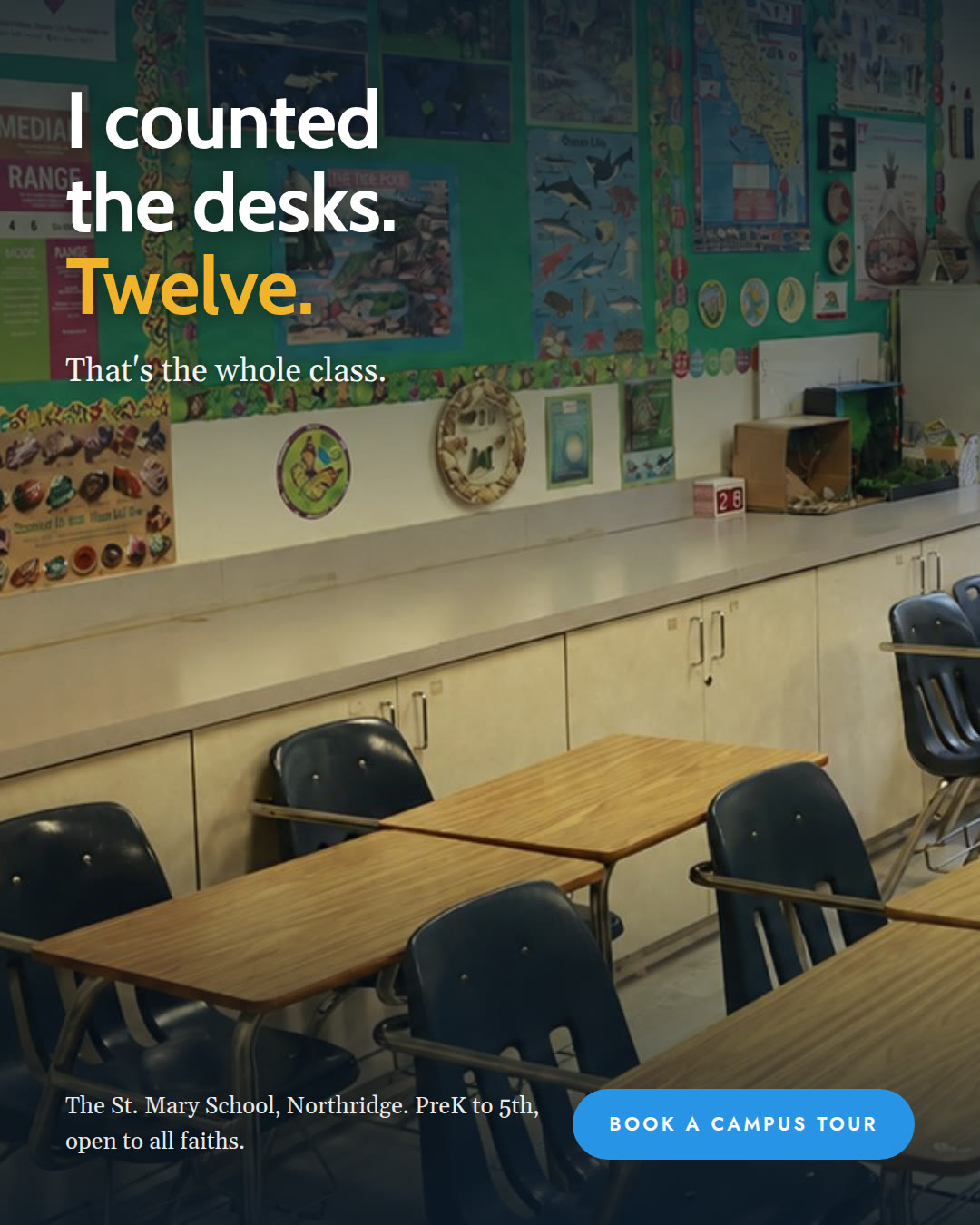
So each ad carries one of those answers. “Open 7 to 6.” “I counted the desks. Twelve.” “You can compare schools for months, or walk one in forty minutes.” A parent scrolling on a phone at nine at night does not want a school’s mission. They want to know if pickup works with their commute.
The photography is the actual campus: the classroom, the building, the desks. Parents can tell the difference between a stock photo and a real room, and a real room is what they are being asked to visit. This is why we shoot the creative ourselves rather than briefing a vendor.
The tour is the only call to action
Every ad, and the page it lands on, asks for one thing: book a campus tour. Not “learn more”, not “download the brochure”, not “apply now”. A tour is the step a parent is ready to take, and it is the step that produces enrollments.
The landing page is built for that one job. Hours, class size, grades, and tuition range answered plainly. The tour form short. The phone number above the fold, tracked, because many parents would rather call than fill in a form. Rolling admissions stated clearly so nobody thinks they missed a deadline.
Targeting a school’s real catchment
A school draws from a radius, and the radius is smaller than most people assume. We run local Meta campaigns tuned to the neighborhoods the school actually enrolls from, to parents of children in the right age range, during the enrollment window. Outside that window the campaign is paused or reduced to a small awareness layer. There is no point booking tours for seats that are already full.
What to measure
Booked tours against open seats. That is the number. Underneath it: cost per booked tour by ad, so the ads that produce tours get the budget and the ones that produce clicks do not; tours that show up versus tours that book; and enrollments from tours, which the school’s admissions office can reconcile.
For St Mary the campaign is live and results will be published after the enrollment window closes. We do not publish numbers before they are real.
If you run a school
Ask your front office what parents ask on the phone. Those questions are your ads. Then look at your landing page and count how many things it asks a parent to do. If it is more than one, it is asking for the wrong thing. The tour is the conversion.
The Marketing Audit is a written diagnosis of your pages, creative, and accounts, with a 90-day plan built around your enrollment window.